With interest rates climbing to levels not seen in several decades, one consequence that has drawn relatively little attention is the strengthening of the U.S. dollar. The dollar touches virtually every corner of financial markets, the broader economy, and daily life. Its value shapes the price of imported goods, the cost of traveling abroad, the revenues of U.S. companies with international operations, and the performance of portfolios that hold foreign assets. The dollar is also influenced by the outlook for U.S. economic growth, prevailing interest rates, and concerns about the national debt. In short, the dollar serves as a kind of mirror for many of the forces at work in global financial markets.
This matters for long-term investors because the dollar has recently climbed back to its highest level since last year's "Liberation Day" tariff announcements. The rebound has been broad-based, with the euro, British pound, and Japanese yen all losing ground as the dollar has gained. Higher Treasury yields are among the most significant drivers of this move, with long-term rates such as the 10-year and 30-year Treasury yields at over 20-year highs. These trends also reflect the Federal Reserve's decision to resume raising policy rates, which naturally pushes shorter-term yields higher.1
Although a stronger dollar offers certain advantages, its overall effects can be nuanced. For consumers, a stronger dollar lowers the cost of importing goods and makes international travel more affordable. On the other hand, it can reduce the competitiveness of U.S. exports. A rising dollar can also weigh on the returns of international investments, just as a falling dollar can provide a lift to those same assets.
So, what is behind the dollar's recent gains, and what do they mean for investors?
The dollar has strengthened against major currencies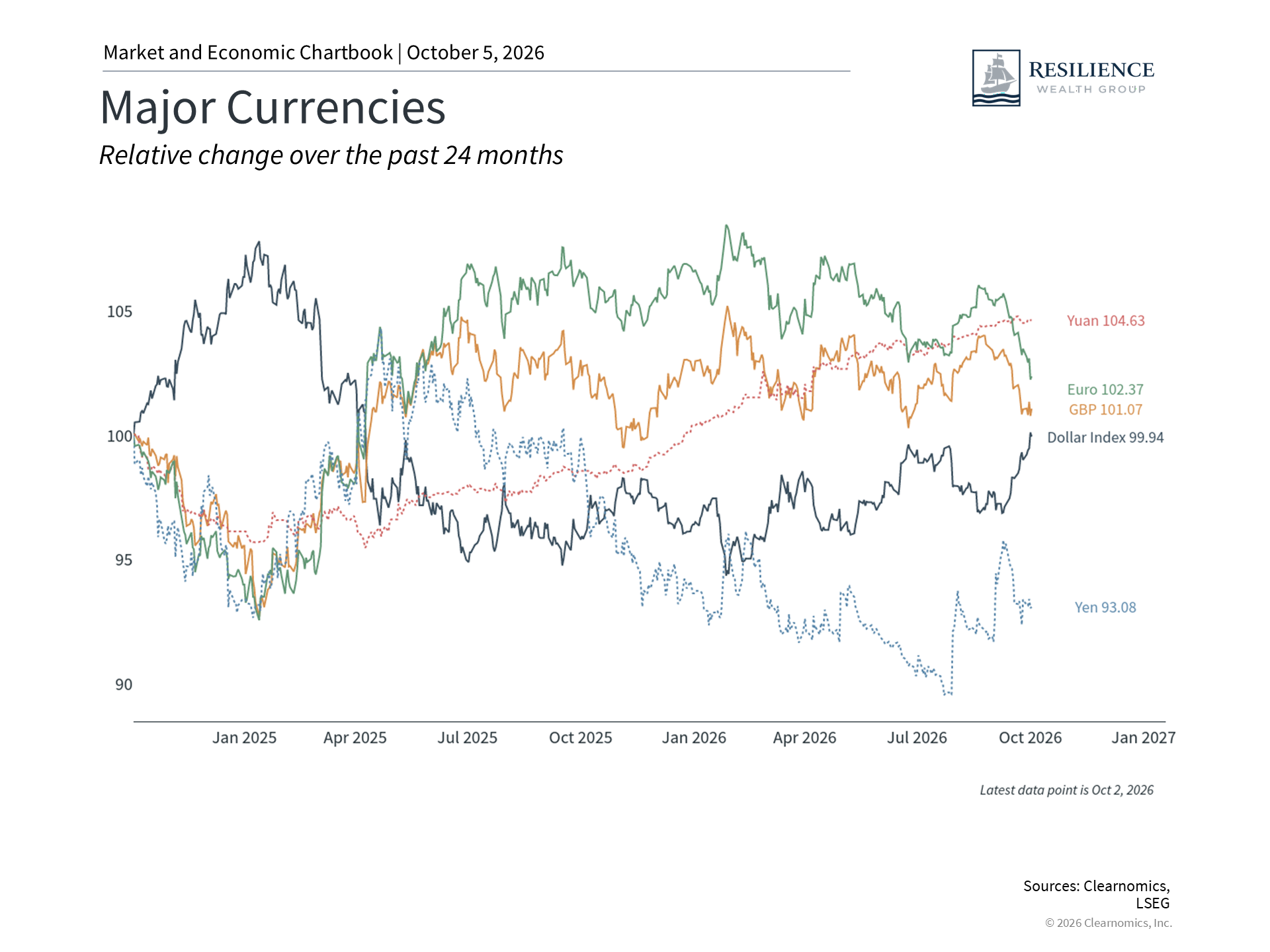 |
The dollar, as measured by the U.S. Dollar Index (DXY), which tracks a basket of six major foreign currencies, has climbed to near 102 after spending roughly a year and a half at or below the 100 level. The chart above, which plots each currency's value relative to where it stood two years ago, illustrates that the dollar has returned to its starting point following a period of weakness. Viewed over a longer horizon, current levels rank among the strongest in nearly 25 years, with the exception of the peaks recorded between 2022 and early 2025, when the index reached as high as 114.2
What has driven the dollar's recovery? A key feature of global markets is that when U.S. interest rates rise relative to those in other countries, dollar-denominated assets become more attractive on a comparative basis. This dynamic is often referred to as the "carry trade." In its most basic form, traders borrow in lower-yielding currencies and deploy those funds into higher-yielding assets such as U.S. Treasuries. As yields rise, capital tends to flow into dollar-denominated assets, providing support for the currency.
This is especially pertinent today because the increase in U.S. rates is not solely a product of inflation. Real, inflation-adjusted rates have also risen, meaning the "true" return investors receive after accounting for price increases has improved. This enhances the appeal of U.S. yields relative to those available in other countries and regions.
That said, predicting dollar movements is notoriously difficult, and the currency does not simply track interest rates in a straightforward way. The dollar can, for instance, appreciate sharply during periods of stress, given its status as a safe-haven asset. At the same time, because the dollar reflects a wide array of economic and global forces, it can be volatile when those forces are in flux, as has been the case over the past several years.
Global and fiscal concerns have led to dollar fluctuations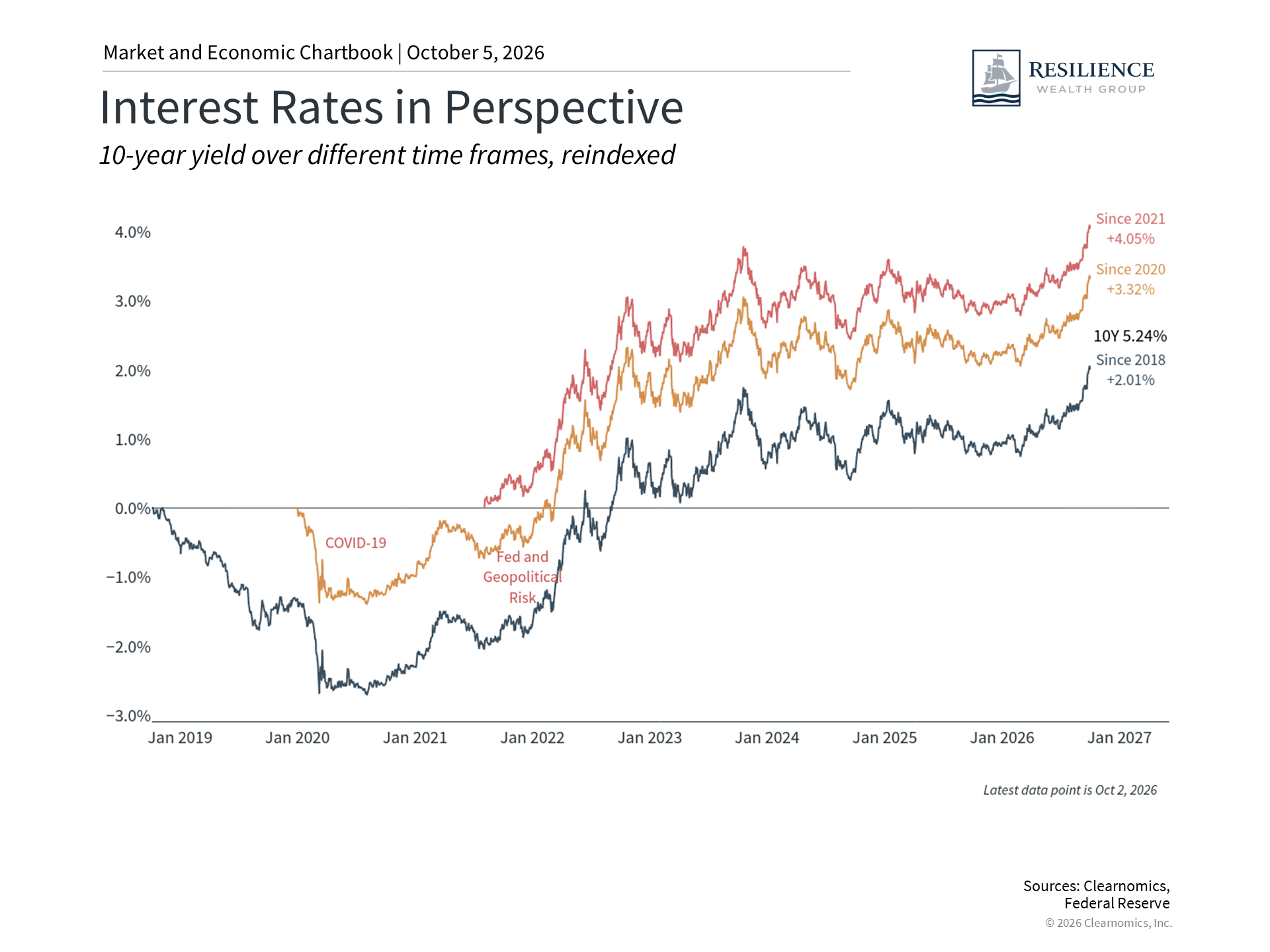 |
Another dimension of the dollar and interest rate relationship involves the effect of the national debt and persistent federal budget deficits. Elevated debt levels can raise doubts about the government's capacity and willingness to meet its obligations, which in turn can put downward pressure on the dollar.
Rising interest rates, with the 10-year yield exceeding 5.3% and the 30-year yield hovering around 5.7%, can compound this problem by increasing the cost of servicing existing debt and making it harder for the government to refinance maturing obligations. Part of the reason yields have risen may itself be attributable to investor concerns about the debt trajectory and growing deficits.
It is therefore noteworthy that the dollar has strengthened despite these pressures, particularly given reports that some global central banks have periodically reduced their reliance on the dollar as a reserve currency in recent years.3 A recurring question is whether there is a threshold at which the debt load becomes unsustainable. This remains largely uncharted territory, with Japan often cited as a reference point, having operated with debt-to-GDP ratios well above 200% for decades.4
Other relevant examples come from Europe, where sovereign debt crises among the so-called PIIGS (Portugal, Italy, Ireland, Greece, and Spain) occurred repeatedly during the 2010s, ultimately necessitating bailouts. Perhaps the most pressing challenge is that fiscal sustainability does not appear to be a central priority in Washington at present.
Notwithstanding these challenges, the U.S. continues to function as a lender of last resort and remains the destination other countries and investors turn to during periods of global stress. As a recent example, the U.S. Treasury Department intervened in the foreign exchange market for the first time since the late 1990s to assist Japan in stabilizing its currency.
From a portfolio standpoint, history suggests that placing too much emphasis on deficits when making investment decisions would often have been counterproductive. Deficits tend to be largest during economic downturns, which are also frequently the periods when equities are most attractively priced. Deficits surged, for example, during the recessions of approximately 2009 and 2020, both of which were followed by robust market recoveries.
Dollar fluctuations can affect international asset returns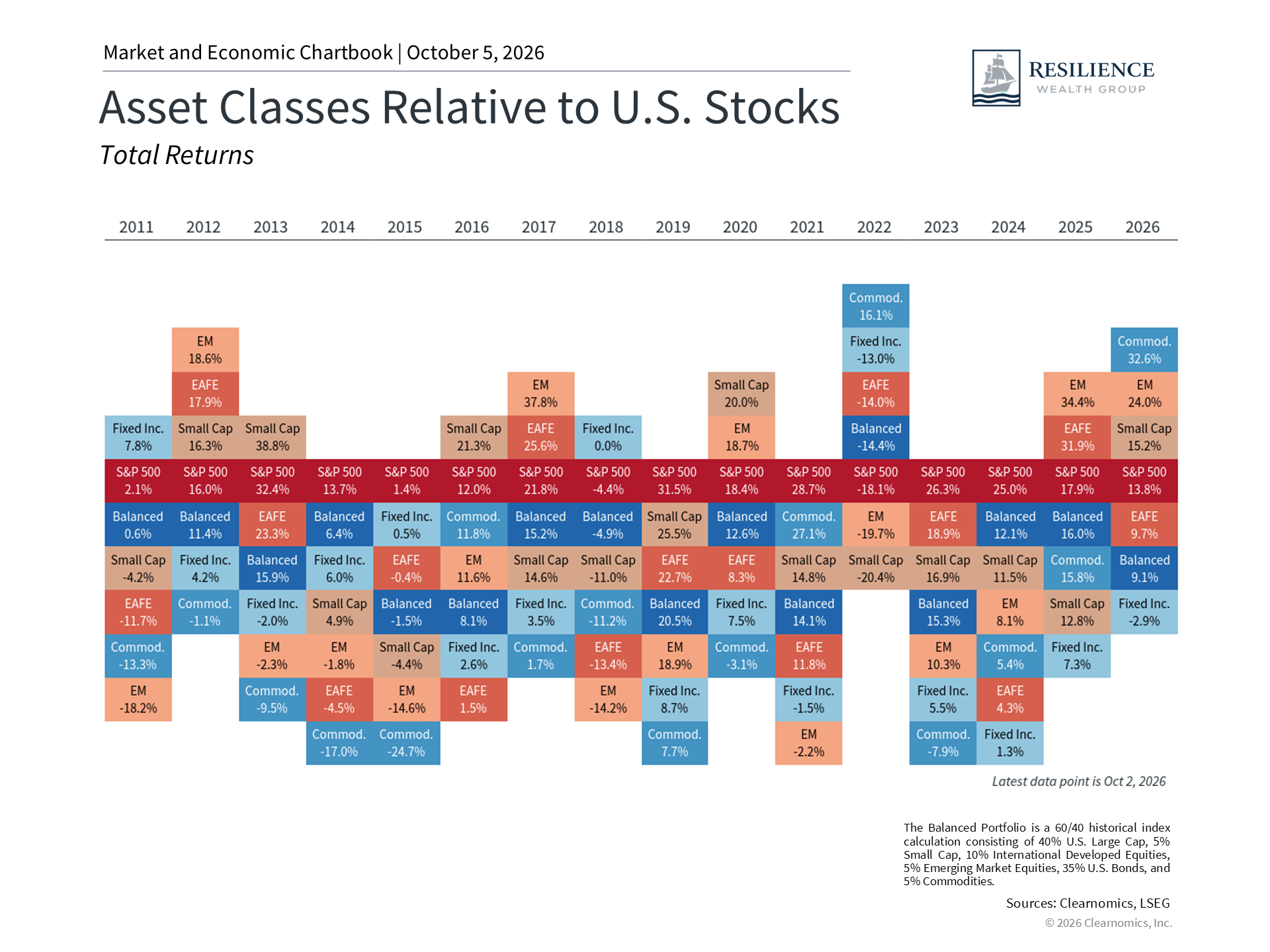 |
For portfolios, this discussion is relevant because currency movements can represent a meaningful component of international investment returns. When U.S.-based investors hold foreign stocks and bonds, those positions are denominated in local currencies that must eventually be converted back into dollars. A weaker dollar increases the value of those foreign holdings in dollar terms, boosting returns, while a stronger dollar has the opposite effect. The same logic applies to U.S. companies that sell goods overseas, since a weaker dollar makes American products more competitively priced for international buyers.
This dynamic acted as a tailwind for diversified portfolios last year, when a softer dollar helped lift returns in both developed and emerging markets. As the dollar has gained ground this year, that effect has reversed. For instance, while emerging markets underperformed during the third quarter, they remain among the top-performing asset classes on a year-to-date basis.5
Currency movements, however, tell only part of the story. Fundamentals such as earnings and valuations remain constructive across both developed and emerging markets, supporting the rationale for maintaining balanced portfolios. The MSCI EAFE Index of developed market stocks and the MSCI EM Index of emerging market stocks currently carry forward price-to-earnings ratios of 14.9x and 9.9x, respectively, compared to 19.2x for the S&P 500.6
Importantly, the dollar retains its position as the world's dominant reserve currency. Concerns about whether this status will endure are not new. Similar questions emerged during Japan's rise in the 1980s, following the introduction of the euro, amid China's economic expansion, and more recently with the growth of digital currencies. In each instance, the dollar maintained its central role, even as the composition of assets held by global institutions shifted somewhat.
For long-term investors, the broader takeaway is that currency movements are one of many factors that influence portfolio returns. These movements can shift rapidly in response to changes in interest rates, geopolitical developments, and economic expectations, as the experience of the past two years has demonstrated. Rather than reacting to these fluctuations, maintaining a well-diversified mix of domestic and international assets that aligns with long-term objectives is the most effective approach to managing them.
The bottom line? The dollar has strengthened over the past year due to higher real interest rates and its role as a safe-haven asset, despite fiscal concerns. Investors should continue to stay balanced across regions as global trends impact the dollar and other currencies.
References
1. https://home.treasury.gov/policy-issues/financing-the-government/interest-rate-statistics
2. Clearnomics research using LSEG data, as of October 2, 2026
3. https://data.imf.org/en/datasets/IMF.STA:COFER
4. https://fiscaldata.treasury.gov/americas-finance-guide/national-debt/
5. Clearnomics research using MSCI data, as of October 2, 2026
6. Clearnomics research using LSEG data, as of October 2, 2026
Index Descriptions
S&P 500
The Standard & Poor's 500 Index is a capitalization-weighted index of 500 stocks designed to measure performance of the broad domestic economy through changes in the aggregate market value of 500 stocks representing all major industries.
MSCI Emerging Markets Index
The MSCI EM (Emerging Markets) Index is a free float-adjusted market capitalization weighted index that is designed to measure the equity market performance of the emerging market countries of the Americas, Europe, the Middle East, Africa and Asia. The MSCI EM Index consists of the following emerging market country indices: Brazil, Chile, Colombia, Mexico, Peru, Czech Republic, Egypt, Greece, Hungary, Poland, Qatar, Russia, South Africa, Turkey, United Arab Emirates, China, India, Indonesia, Korea, Malaysia, Philippines, Taiwan, and Thailand.
MSCI EAFE Index
The MSCI EAFE Index is a free float-adjusted market capitalization index that is designed to measure the equity market performance of developed markets, excluding the U.S. & Canada. The MSCI EAFE Index consists of the following developed country indices: Australia, Austria, Belgium, Denmark, Finland, France, Germany, Hong Kong, Ireland, Israel, Italy, Japan, the Netherlands, New Zealand, Norway, Portugal, Singapore, Spain, Sweden, Switzerland and the UK.
Bloomberg U.S. Aggregate Bond Index
The Bloomberg U.S. Aggregate Bond Index is an index of the U.S. investment-grade fixed-rate bond market, including both government and corporate bonds.
DXY
The DXY is a U.S. dollar index based on a basket of currencies, including the Euro, Yen, Pound, Canadian Dollar, Swedish Krona and Swiss Franc.