Even the healthiest seed will struggle if planted in the wrong soil. The same principle applies to investments, as some assets benefit from being held in specific account types, particularly in terms of how they are taxed. This concept is commonly known as "asset location," which has nothing to do with geography. Rather, it is the practice of placing each investment in the account type where it can grow most efficiently. These account types may include a taxable brokerage account, a tax-deferred account such as a traditional IRA or 401(k), or a tax-free account such as a Roth IRA.
Most investors spend a great deal of time thinking about what to invest in, but where those investments are held can be equally important. Unlike asset allocation, which focuses on diversifying across asset classes such as stocks and bonds, asset location is centered on maximizing after-tax outcomes. This is, after all, the figure that truly matters for financial planning. The ultimate objective of asset location is to improve the likelihood of reaching financial goals over an investor's lifetime. With that in mind, what key factors should investors be considering today?
Matching investments to the right account type is essentialUnderstanding asset location begins with two foundational concepts. The first is that investment accounts can be broadly divided into taxable and tax-advantaged categories. Taxable accounts are those where gains may be subject to ordinary income rates, capital gains rates, or other applicable taxes depending on the situation. Tax-advantaged accounts, by contrast, offer various forms of protection from taxes, though each comes with its own set of rules and restrictions.
The second concept is that investments vary in their degree of tax efficiency. An investment is considered tax-inefficient when a portion of its return is eroded by taxes each year. This often occurs because the investment generates income taxed at ordinary income rates, such as interest from corporate bonds, or because it regularly distributes short-term capital gains, as some funds do.
The goal of asset location, therefore, is to shelter tax-inefficient investments inside accounts that protect their income from taxation, while using taxable accounts for investments that are likely to be held long-term or already benefit from favorable tax treatment.
While this concept may appear straightforward, implementing it in practice requires careful planning. Contribution limits on tax-advantaged accounts and rules governing withdrawals often add complexity to the process.
A range of account types offers multiple planning opportunities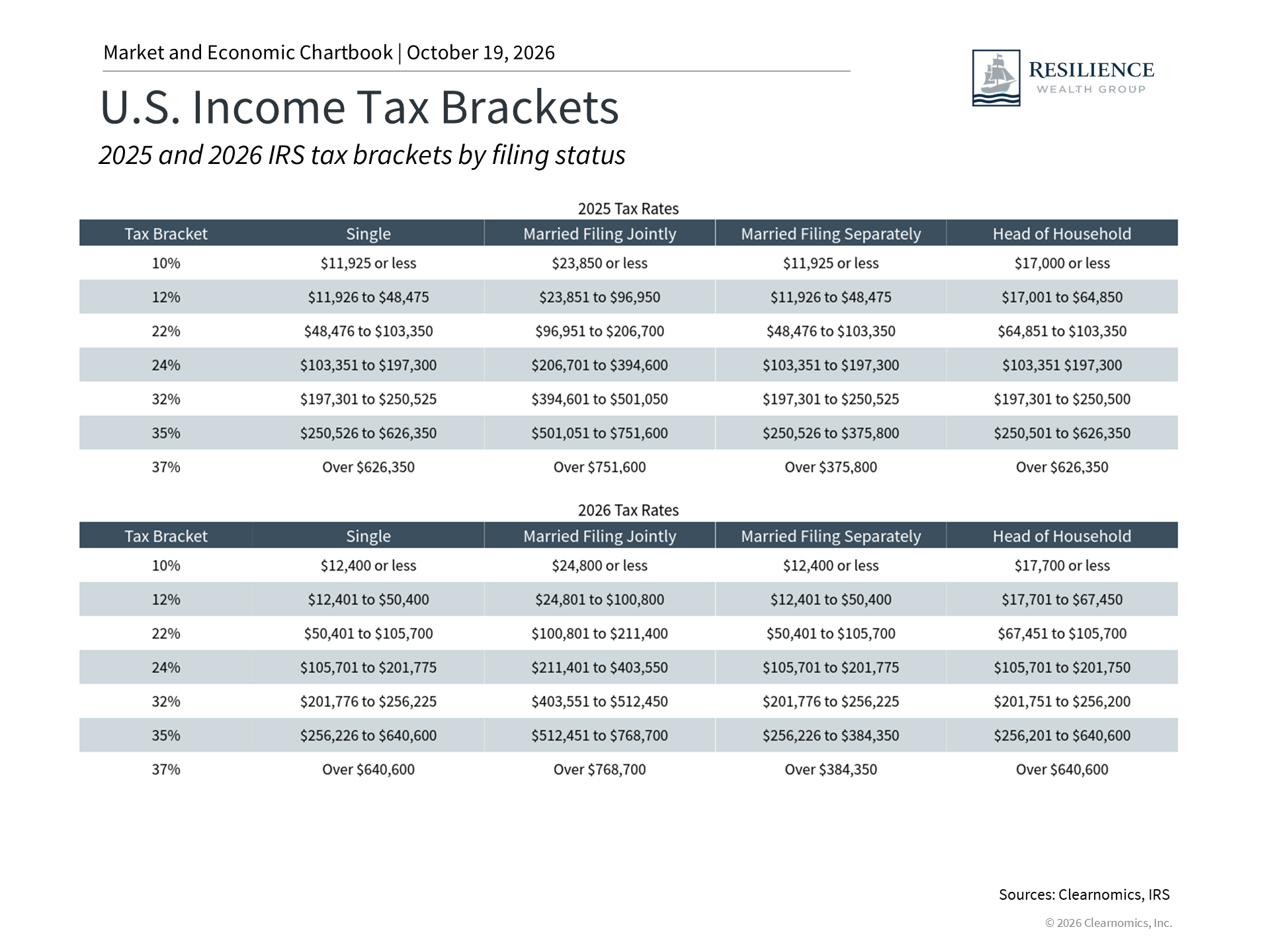 |
Taxable accounts, such as traditional brokerage accounts, offer notable flexibility and liquidity. They carry no withdrawal age restrictions, no contribution limits, and no early withdrawal penalties. The primary drawback is that these accounts are subject to current taxation on dividends, interest, and realized capital gains. Interest income and short-term gains are taxed at ordinary income rates, while qualified dividends and long-term capital gains benefit from preferential tax rates.1 The accompanying chart illustrates the federal income tax rates and brackets for 2026, which reach a peak of 37%, while the long-term capital gains tax rate peaks at 20%.2
Given this structure, taxable accounts are generally well suited for tax-efficient or tax-exempt investments, such as low-dividend stocks held over the long term and exchange traded funds (ETFs) with low turnover. Municipal bonds are another example, since their interest is generally exempt from federal taxes and, in some cases, state income taxes as well. Although these accounts do not come with built-in tax benefits, strategies such as tax loss harvesting or charitable gifting can help manage annual tax exposure.
Tax-advantaged accounts encompass a variety of vehicles, including Roth IRAs, employer-sponsored 401(k) plans, and others. With Roth IRAs, contributions are non-deductible, but earnings can grow tax-free, and qualified withdrawals are not subject to tax. This structure can make Roth accounts particularly attractive for assets with higher expected growth, since much of the potential appreciation can compound without generating a future tax liability.
Traditional IRAs operate differently, allowing pre-tax contributions while taxing withdrawals at ordinary income rates. Because earnings are reinvested without being taxed annually, the overall account balance can grow more quickly than in a standard taxable account. These accounts are well suited for income-heavy or tax-inefficient assets that would otherwise generate taxable income each year. Examples include high-yield fixed income securities, high-dividend stocks, and Real Estate Investment Trusts (REITs).
Long-term planning considerations investors should keep in mindBuilding an effective asset location strategy begins with assessing individual needs, including liquidity requirements, major planned expenses, higher education funding, retirement income, and time horizon. These factors help determine the most appropriate mix of account types and inform the trade-offs involved in holding funds in specific vehicles.
One key consideration is the balance between long-term investing and short-term liquidity. Placing money in certain accounts for extended periods can limit access when funds are needed. A Roth IRA, for instance, can serve as a liquidity valve because original contributions may be withdrawn tax-free and penalty-free at any time.3
For estate planning purposes, taxable brokerage accounts have traditionally served as short-term liquidity pools and can also be effective vehicles for transferring wealth. Assets in these accounts receive a step-up in basis upon the owner's death, which means heirs may avoid larger capital gains taxes and preserve more wealth for transfer.4
Investors can also match assets to specific financial goals through Health Savings Accounts (HSAs) and education funding vehicles. HSAs offer a unique triple-tax advantage, making them an excellent tool for long-term growth when current medical expenses can be paid out of pocket and the balance is allowed to accumulate over time. For education goals, 529 plans allow assets to grow tax-free.
It is also worth noting that future changes to tax laws could affect asset location strategies. Investors should factor in the added management complexity and time needed to monitor and adjust this strategy on an ongoing basis.
Ultimately, taxes are just one element of a broader financial plan, so asset location should support overall financial objectives rather than simply reducing taxes in the current year. For retirees, this may mean optimizing asset placement to support tax-efficient withdrawals, such as drawing from taxable accounts first to preserve tax-free growth. For those still accumulating wealth, it can mean enhancing after-tax compounding and turning incremental savings into greater lifetime value.
Rather than viewing each account in isolation, investors can unlock the full tax efficiencies available by treating these vehicles as an interconnected system. Asset location plays a meaningful role in investment and retirement planning strategy. While many investors focus on refining the assets they own, the decision of where to hold those assets carries equal importance.
The bottom line? Asset location can support financial goals, bridging investment strategy and tax planning. By aligning the right account structures with the right asset types, and viewing these choices through the lens of broader financial planning, investors can potentially enhance after-tax returns without changing their overall investment mix.
References
1. https://www.irs.gov/taxtopics/tc409
2. https://www.irs.gov/filing/federal-income-tax-rates-and-brackets
3. https://www.irs.gov/publications/p590b
4. https://www.irs.gov/publications/p559